
The Philosophical and Pedagogical Potential of AI-Generated Mathematics-Themed Philosophy for Children (P4C) Stories
Article Sidebar
Main Article Content
Abstract
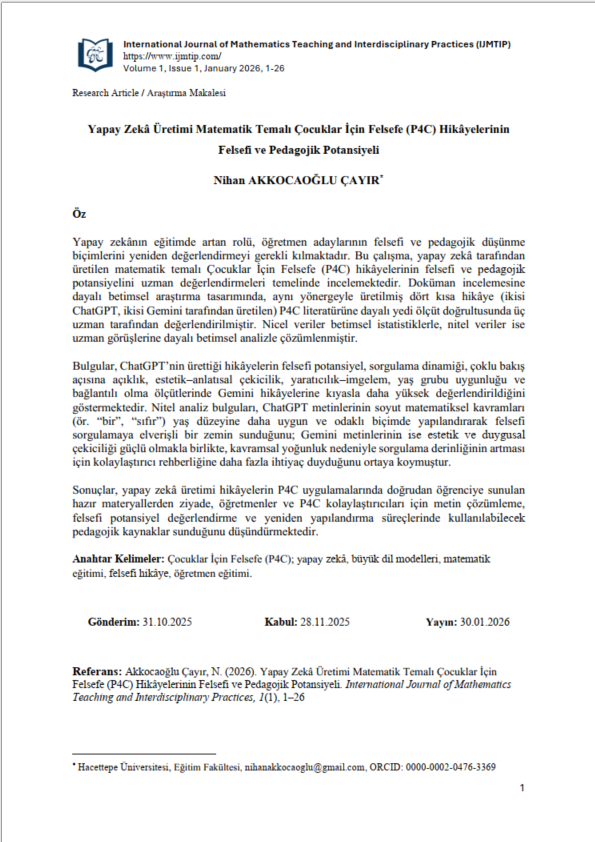
The growing role of artificial intelligence (AI) in education requires teacher candidates to reconsider their philosophical and pedagogical ways of thinking. This study examines the philosophical and pedagogical potential of AI-generated stories designed for Philosophy for Children (P4C) with a mathematics focus. Adopting a descriptive research design based on document analysis, four short stories (two by ChatGPT and two by Gemini) generated under the same prompt were evaluated by three experts according to seven criteria derived from the P4C literature. Quantitative data were analyzed through descriptive statistics, while qualitative data were interpreted using descriptive analysis based on expert commentaries.
Findings indicate that ChatGPT-generated stories scored higher than those by Gemini in philosophical potential, inquiry dynamics, openness to multiple perspectives, aesthetic–narrative appeal, creativity–imagination, age appropriateness, and connectivity. Qualitative analyses showed that ChatGPT stories effectively transformed abstract mathematical concepts (e.g., “one,” “zero”) into age-appropriate and metaphorically rich narratives, while Gemini stories, though aesthetically and emotionally appealing, required greater facilitation to sustain philosophical dialogue.
Overall, the results suggest that AI-generated stories can serve not only as “philosophical stimuli” in P4C classrooms but also as reflective and pedagogical tools for teacher and facilitator education through activities such as text analysis, philosophical rewriting, and inquiry-based reflection.
Article Details
Issue
Section

This work is licensed under a Creative Commons Attribution-NonCommercial 4.0 International License.
License
All articles are published under the Creative Commons Attribution–NonCommercial–NoDerivatives 4.0 International License (CC BY-NC-ND 4.0).
Under this license, you may read, download, copy, and share the material for non-commercial purposes, provided that you give appropriate credit, provide a link to the license, and indicate if changes were made. You may not distribute modified material (including translations, adaptations, or other derivative works).
License link: https://creativecommons.org/licenses/by-nc-nd/4.0/