
The Effect of Cartoon-Supported Teaching Process on Mathematics Achievement and Attitude
Article Sidebar
Main Article Content
Abstract
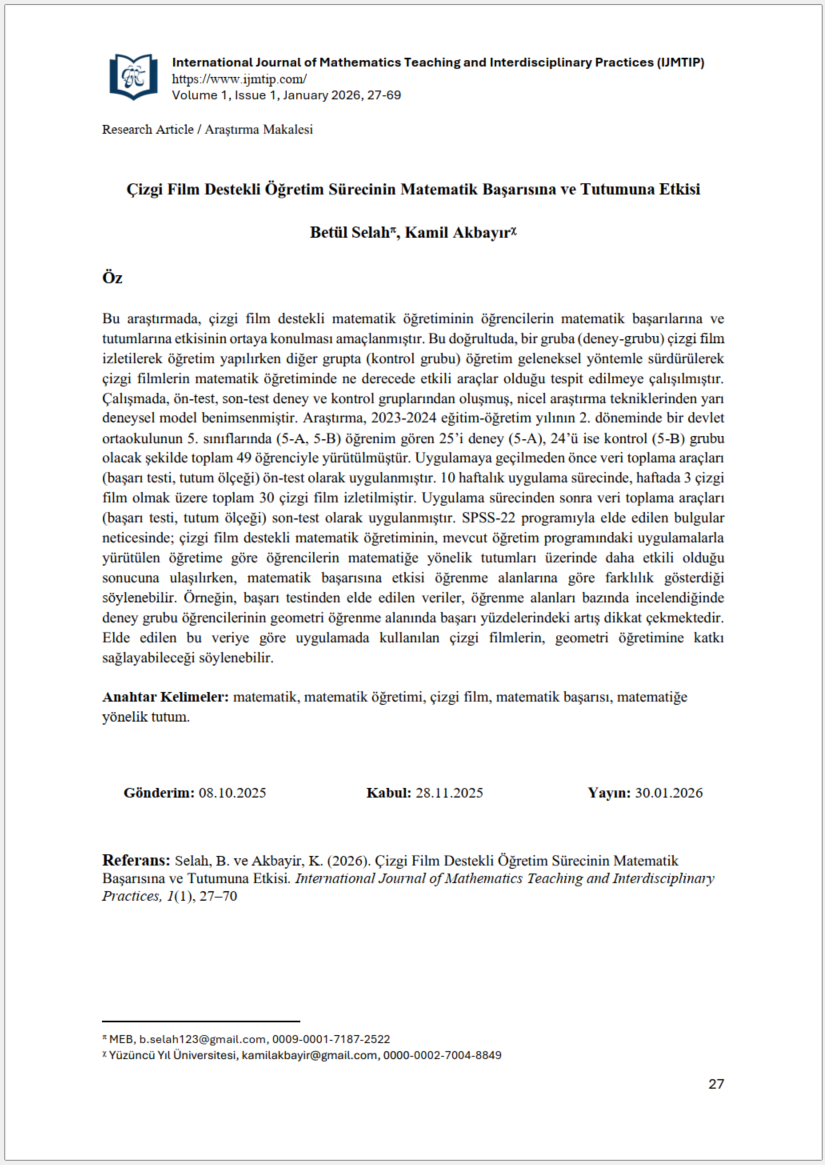
This research aims to determine the effect of cartoon-supported mathematics teaching on students' mathematics achievement and attitudes. In this regard, it was tried to determine to what extent cartoons are an effective tool in teaching mathematics by watching cartoons for one group (experimental group) and teaching the lesson with the traditional method to the other group (control group). The study consisted of pre-test, post-test experimental, and control groups, and a quasi-experimental model, one of the quantitative research techniques, was adopted. The research was conducted in the 2nd semester of the 2023-2024 academic year with 49 students in the 5th grades (5-A, 5-B) of Sempaş Secondary School in İpekyolu district of Van province. 25 were the experimental group (5-A) and 24 were the control group (5-B). During the 10-week application period, 30 cartoons were used, 3 cartoons per week. After the implementation, data collection tools (achievement test, attitude scale) were applied as a post-test. As a result of the findings obtained with the SPSS-22 program; While it was concluded that cartoon-supported mathematics teaching was more effective on students' attitudes towards mathematics than teaching with the applications in the current program, no statistically significant difference was detected in mathematics achievement. However, when the data obtained from the achievement test are examined based on learning areas, the increase in the success percentage of the experimental group students in geometry learning draws attention. According to this data obtained, we can say that the cartoons used in the application can contribute to geometry teaching.
Article Details
Issue
Section

This work is licensed under a Creative Commons Attribution-NonCommercial 4.0 International License.
License
All articles are published under the Creative Commons Attribution–NonCommercial–NoDerivatives 4.0 International License (CC BY-NC-ND 4.0).
Under this license, you may read, download, copy, and share the material for non-commercial purposes, provided that you give appropriate credit, provide a link to the license, and indicate if changes were made. You may not distribute modified material (including translations, adaptations, or other derivative works).
License link: https://creativecommons.org/licenses/by-nc-nd/4.0/